ET wz. 40 Filipinka impact grenade
Simple 3d models and renders based on ww2 Polish resistance/partisan manufactured (specifically by the group "Armia Krajowa" or AK for short) ET wz. 40 offensive impact hand grenades which would detonate on impact when armed and thrown while still being a simple and cheap to produce homemade/improvised grenade which could be mass-produced while Poland was under Nazi occupation during the second world war in a time when material shortages were a big problem for what was left of the Polish military and to the many resistance/partisan cells in Poland, to meditate this a man named Edward Tymoszak, a person whom formerly worked in the Polish army came up with the design for the ET wz. 40 grenade and after whom the grenades are named, ET being an abbreviation of his initials and the common nickname of the grenades "Filipinka" coming from Edward's pseudonym "Filip" The grenades were also known by Wańka, Perełka too.
Early production ET wz. 40 Filipinka models were made with bodies of bakelite an early type of plastic, only about four 4,000 of these early models were made but then were quickly replaced with the more numerously manufactured model with cheaper and easier-to-make stamped sheet metal bodies of which about 240,000 were made. This sheet metal body also increased the durability of the grenades and also their fragmentation effect as the more brittle bakelite of the early models would disintegrate into dust under detonation producing barely any shrapnel or simply could be accidentally damaged more easily. The later sheet metal models also incorporated a clever tactic to hide the origin of these grenades from the Nazis in case some get captured, this was done by painting on Russian writing to confuse the Nazis to think that the grenades were not actually made by the Polish resistance but by the approaching Red army of Russia. The Russian marking is also where the other nickname Vańka comes from as the Cyrillic letters ДУГ painted is short for "diesantnaja udarnaja granata"
For the explosive compounds used in the grenades impact fuzes, detonators, and as the main explosive charge, easily produced and acquired explosive compounds were used such as mercury fulminate as the primer compound in the fuze which would then detonate the other mercury fulminate booster charge and main detonator charge composed of TNT in the grenades detonator. The main explosive charge of the grenades was most commonly made up of Cheddite a compound made from potassium chlorate and vegetable vats. Another but less commonly used explosive compound used in the grenades was (anal or AN/AL, tannerite) WHich was composed of Ammonium nitrate granules mixed with aluminum powder. There also were rare cases of other explosive compounds from capture Nazi munitions being used and even some donated British explosives were used too.
Been trying my best at getting somewhat "decent" in substance painter and I finally also got a new better GPU so I can finally actually use the softwater without it crashing constantly on me lol
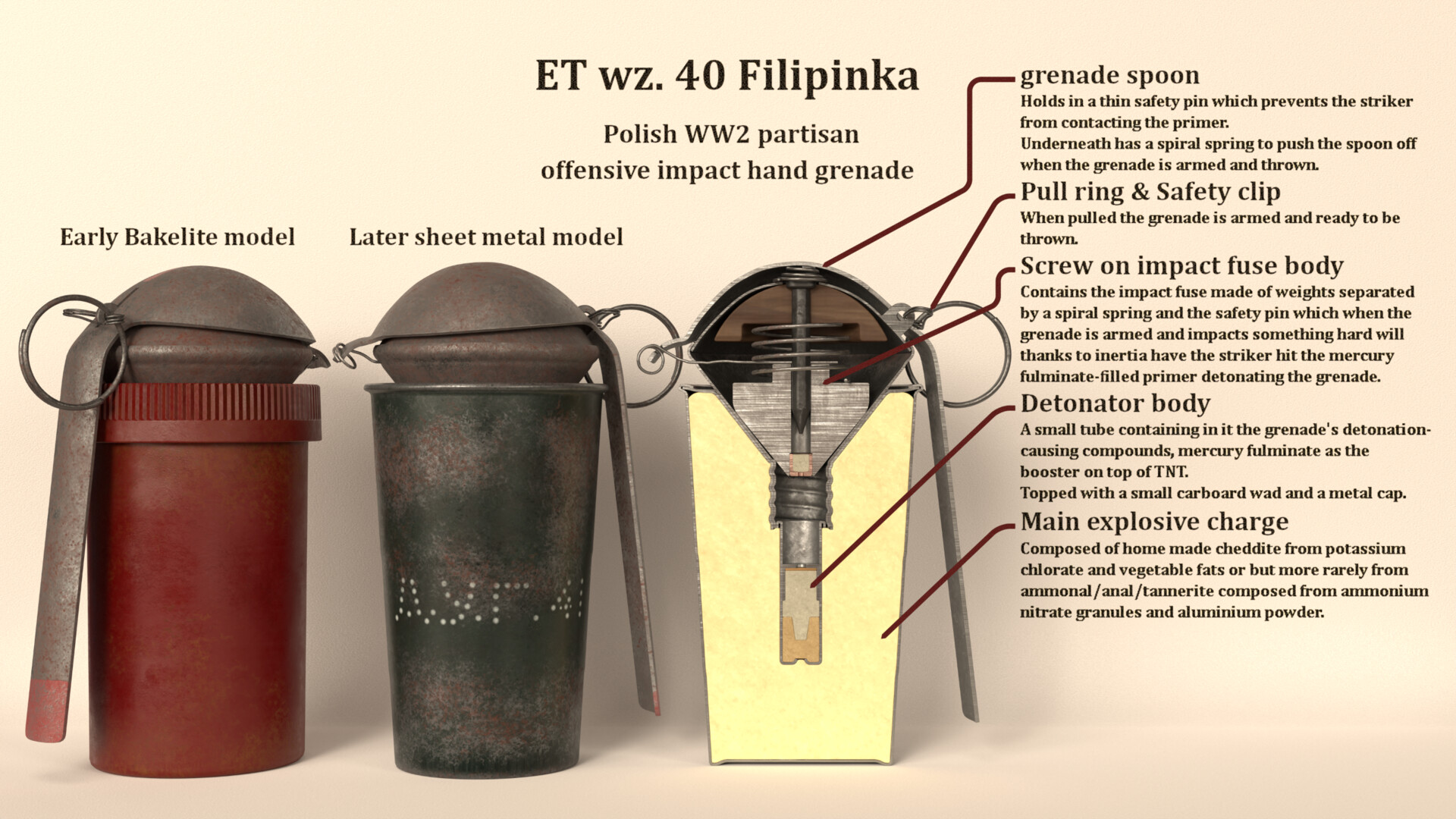

Later sheet metal model

Earlier bakelite model